
We live in a world where friction is engineered out of everything that matters. Shopping, banking, learning—every experience is fast, intuitive, and designed to just work. You can order a phone, book a cab, or start a course in minutes.
And then you apply for a job.
Re-enter the same details. Create an account you’ll never use again. And then… you wait.
No confirmation. No timeline. No update. Just silence.
That’s the gap —and at its core, the growing candidate experience crisis.
While companies treat hiring as a process to manage, candidates experience it as a product. They evaluate, compare, and form opinions on culture and leadership long before the first conversation.
In 2026, how you hire will matter as much as who you hire. In a world where attention is limited and trust is earned quickly; hiring isn’t just a process and candidate experience is your employer brand in action.
We’ve designed world-class customer experiences—but left hiring stuck in another decade. Organizations must move beyond checkbox hiring and view candidate experience as a strategic lever that drives performance, reputation, revenue, and future hiring success.
The Shift No One Can Ignore Anymore
The gap between job application and recruiter response to candidate is not new. It just costs more now. Candidates accepted delayed hiring when talent was abundant and information was limited. They won’t today.
Three forces changed the equation:

Talent is Selective:
Top candidates in IT, healthcare, and engineering routinely choose from multiple offers.

Reputation is Transparent:
Candidates check employee posts and reviews—often before a recruiter ever reaches out.

Hiring hasn’t kept up:
While customer experience is AI-driven and real-time, the talent acquisition experience remains transactional and slow.
Candidates have advanced. The hiring experience hasn’t. That’s the gap where recruiters lose talent making it clear why candidate experience matters more than ever.
Hiring as a Product, Not a Process
Most organizations still think of hiring as a workflow—requisitions, pipelines, and time-to-fill. But for candidates, it’s a completely different experience.
They’re measuring:

Ease of application

Response time

Clarity of communication

Consistency and fairness of evaluation
And like every other human being, they don’t evaluate the job application in isolation. They’re comparing it—consciously or not—to every other digital experience they’ve had recently.
This is the Amazon Effect.
Not because hiring should simulate e-commerce, but because expectations have fundamentally shifted. Amazon trained people to expect one-click simplicity. Netflix normalized instant, personalized recommendations. Spotify conditioned users to expect platforms that anticipate their needs.
When those expectations meet a 30-minute job application, a forced account creation, and four days of silence—candidates don’t complain. They abandon intensifying the candidate experience crisis organizations are now facing.
Data Makes It Hard to Ignore
Candidate experience is no longer a ‘nice to have.’ It directly impacts conversion, brand, and hiring outcomes.


The business cost is just as real. Virgin Media once lost £4.4 million in annual revenue because rejected candidates—who were also customers—switched to competitors. That’s a hiring process with a measurable line on the P&L.
The question is no longer why candidate experience matters. The question is whether the experience itself has become as important as the reputation it either builds or destroys.
What It Looks Like in Practice
Today’s staffing candidate experience is often decided in moments.
Imagine a candidate browsing roles on their phone between meetings.
They land on a job posted by your organization.
The description feels generic → They keep scrolling
The application looks long → They save it for later (and never return)
They apply anyway → No confirmation arrives
Days pass → Still no update
Meanwhile, another company provides a better talent acquisition experience —reaching out within 48 hours, clearly outlining next steps, and keeping the conversation going.
The candidate makes their decision before compensation is even discussed.
That’s hiring today: quiet, fast, and entirely experience-driven.
What Does ‘Amazon-Like Hiring’ Actually Mean?
It means designing hiring like a customer journey—intentional, seamless, and end-to-end. It’s about intent—and a cautious candidate experience strategy.
Mobile-first where it matters
Structured and fair by default
Human-centered, even with AI
In a market where silence loses candidates, a strong candidate experience strategy becomes a competitive advantage.
Reimagining the 5-Stage Candidate Experience through the B2C Lens
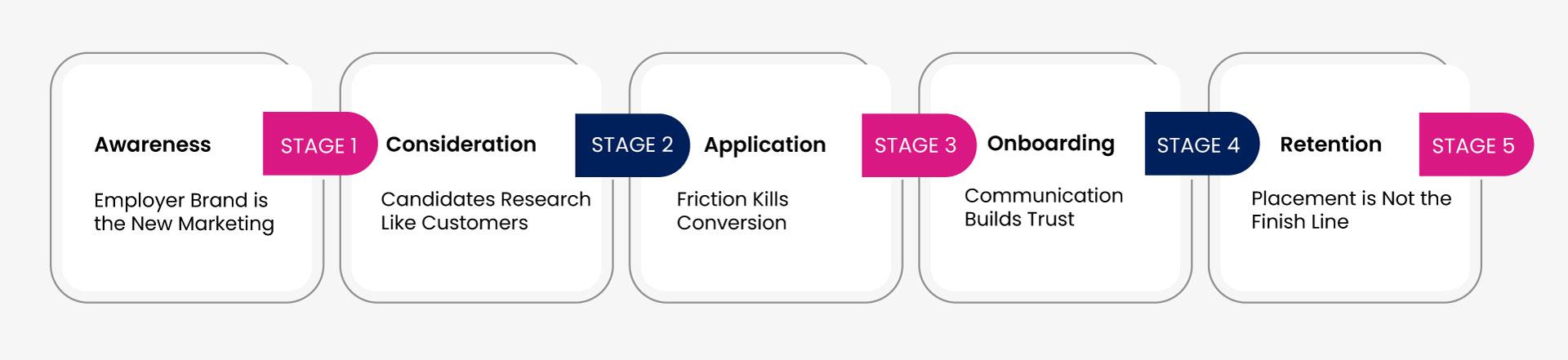
1. Awareness — “Why notice you?”
B2C: Brands build visibility early through content, storytelling, and constant presence.
Talent: Candidates should encounter your brand before they need a job.
Where it breaks: Most companies appear only when roles open.
What better looks like: Candidates already know your story before they see your job posting.
2. Consideration — “Can I trust you?”
B2C: Customers compare, validate, and look for social proof.
Talent: Candidates seek clarity on culture, career growth, and expectations.
Where it breaks: Generic job descriptions, limited cultural visibility, and unmanaged reviews.
What better looks like: Candidates don’t have to interpret—make the candidate experience tangible.
3. Application — “Is the next step worth it?”
B2C: Checkout is instant, mobile-first, and frictionless.
Talent: Application should match that level of simplicity.
Where it breaks: Lengthy forms, forced logins, no acknowledgment. Every extra step weakens the hiring experience.
What better looks like: Apply in minutes. Immediate confirmation. Clear next steps.
4. Hiring & Onboarding — “Do they respect my time?”
B2C: Post-purchase communication builds confidence and trust.
Talent: Candidates need clear timelines, proactive updates, and preparation support.
Where it breaks: Silence, delays, and impersonal template responses.
What better looks like: Candidates feel guided—not left guessing. A structured, responsive candidate experience strategy builds trust here.
5. Retention & Redeployment — “Is this a relationship or a transaction?”
B2C: Loyalty programs, re-engagement campaigns, and community building drive repeat business.
Talent: The relationship shouldn’t end at placement—it should compound.
Where it breaks: Most staffing organizations disengage after placement. The numbers are stark: 93% of temp workers are never redeployed, meaning firms restart the entire acquisition cycle at significant cost.
What better looks like: Build a talent ecosystem. Candidates return because the experience made it worth coming back.
5. Retention & Redeployment — “Is this a relationship or a transaction?”
B2C: Loyalty programs, re-engagement campaigns, and community building drive repeat business.
Talent: The relationship shouldn’t end at placement—it should compound.
Where it breaks: Most staffing organizations disengage after placement. The numbers are stark: 93% of temp workers are never redeployed, meaning firms restart the entire acquisition cycle at significant cost.
What better looks like: Build a talent ecosystem. Candidates return because the experience made it worth coming back.
Why Most Organizations Struggle to Deliver This
It’s not a strategy problem. It’s a tooling problem.
Traditional ATS platforms were built to track and comply—not to engage. They bring structure to hiring, but do not offer a meaningful candidate experience. And candidate journeys today are not linear: candidates pause, drop off, return weeks later, get referred, and engage across multiple touchpoints before applying.
Legacy ATS stacks weren’t designed for this reality. Three structural gaps define the problem:

Compliance over experience:
Systems record activity but don’t actively drive engagement.

Linear workflows vs. real behavior:
Hiring funnels assume a neat, step-by-step progression. Actual candidate behavior doesn’t.

No post-placement framework:
Most stacks lack mechanism for re-engagement, redeployment, or long-term relationship management.
The shift isn’t just about adding a better tool onto an existing stack. It’s about rethinking philosophy: from managing steps to building relationships.
What that requires is an engagement layer that enables a true candidate experience strategy—a layer that adds what ATS lacks:
- Always-on talent pools, not one-time pipelines
- Timely, personalized communication, not silence
- Full lifecycle visibility, not point-in-time tracking
- Context-aware automation that feels human, not robotic
When those elements work together, the hiring experience stops feeling like a system—and starts feeling like a relationship. Candidates feel recognized. Recruiters stop chasing updates. Organizations stop restarting pipelines fromscratch.
That’s when hiring becomes a product: intuitive, responsive, and trust-building by design.
Closing the Gap: How WorkLLama Manages Talent Like a Customer Journey
Most staffing technology was built to track, not to engage. It records applications, stores résumés, and flags compliance checkboxes—but it was never designed to build a relationship. The result is a fragmented candidate experience—one that starts strong at sourcing and quietly falls apart at every stage that follows.
WorkLLama was built from the opposite assumption: that a candidate deserves the same continuity of experience a customer engaging with a trusted brand. Not a feature bolted onto an ATS, but a unified platform designed to elevate the full talent acquisition experience—from first discovery to redeployment.
Here’s what that looks like in practice across each stage.
Attraction that works before a candidate is ready to apply
Most job postings wait for intent. WorkLLama builds it.
Through SEO-optimized career sites, branded mobile apps, and referral-driven social sharing, it creates an always-on presence in the markets where talent actually lives—so when a candidate is ready to move, your organization is already familiar.
Engagement that doesn’t drop off between interest and application
The consideration phase is where most pipelines quietly leak fueling the candidate experience crisis.
Candidates research, hesitate, and disappear—often because there’s nothing to hold their attention. WorkLLama addresses this with rich, branded job content, employee community forums, and AI-powered nurturing that keeps candidates warm without requiring recruiter bandwidth. The pipeline doesn’t get cold; it stays in motion.
An application experience that doesn’t punish intent
A candidate who wants to apply should be able to do so in less than two minutes. WorkLLama’s one-click apply, SMS accessibility, and mobile-first design remove the friction that causes drop-off at the moment of highest intent. The goal is simple: get out of the candidate’s way.
Onboarding that replaces silence with structure
The gap between offer and day one is where trust either solidifies or erodes. WorkLLama automates communication at every milestone:
Application → Instant acknowledgment

Screening → Prepare resources

Interview → Reminders and directions

Offer → Digital acceptance

First Day → Welcome and check-in
Candidates don’t wonder what’s happening next. They’re told.
Retention that treats placement as a beginning, not an end
This is where most staffing firms fall short—and where WorkLLama redefines staffing candidate experience. Through structured lifecycle check-ins, proactive redeployment workflows triggered 30 days before an assignment ends, and real-time NPS feedback loops, it keeps the relationship alive long after placement. Talent that feels valued comes back. Talent that feels forgotten doesn’t.
The shift WorkLLama enables isn’t just operational, it’s philosophical. Hiring stops being a transaction that ends at placement and becomes a continuous, compounding relationship with talent. That’s not just better candidate experience, that’s a more resilient, lower-cost, higher-quality approach to workforce building.
Companies That Design for Experience Will Win
Candidates don’t distinguish between your hiring process and your brand. To them, it’s the same thing.
Every delay, every unclear message, every moment of silence communicates something about how your organization operates. The best candidates read those signals quickly—and make their decisions accordingly.
The question is no longer ‘Are we hiring efficiently?’
It’s ‘Are we creating a candidate experience that people trust, remember, and choose?’
In today’s market, the best candidates don’t wait. They don’t chase updates. And they rarely give second chances. They expect clarity, speed, and respect. Organizations that deliver those fundamentals silently prevent attrition before it begins: no complaints, no feedback, just absence.
The shift from ATS-led processes to experience-led ecosystems, from one-time placements to continuous talent engagement, from filling roles to building relationships, it’s already underway.
Customer experience determines how you win markets, candidate experience defines who helps you win them.
If you’re rethinking how your hiring experience performs at scale, it’s worth seeing what a modern, experience-led approach looks like in action.

