
The Personalization Paradox in Recruiting
The most promised and least fulfilled promise in contemporary recruiting is personalization.
Despite significant investments in recruiting automation and sourcing tools, only 26% candidates report a positive hiring experience, while 60% describe it as poor, not because what passes for recruitment personalization is a name in a subject line and a job title in the opening sentence.
Personalization helps; outreach emails with a name, role, and company can generate up to 68% open rates and 24% replies. However, it is still surface-level engagement.
This is the paradox.
Employers want candidates to feel understood. However, high-volume hiring drives recruiting toward industrialized workflows. Recruiters are expected to humanize engagement at scale, but fragmented data, manual processes, and template-led outreach make meaningful personalization nearly impossible.
The issue isn’t intent, it is the operating model.
Organizations struggle with personalization in recruitment not because organizations lack intent, but because the operating model wasn’t built to support dynamic talent segmentation, or AI-driven engagement at scale.
While companies treat hiring as a process to manage, candidates experience it as a product. They evaluate, compare, and form opinions on culture and leadership long before the first conversation.
In 2026, how you hire will matter as much as who you hire. In a world where attention is limited and trust is earned quickly; hiring isn’t just a process and candidate experience is your employer brand in action.
We’ve designed world-class customer experiences—but left hiring stuck in another decade. Organizations must move beyond checkbox hiring and view candidate experience as a strategic lever that drives performance, reputation, revenue, and future hiring success.
| S. No. | Pressure Point(s) | Cause | Effect |
| 1 | Manual Personalization Doesn’t Scale | High-volume pipelines limit time and context | Efficiency replaces engagement |
| 2 | Fragmented Context Weakens Empathy | Candidate data is scattered across several platforms | Disconnected experiences |
| 3 | Metrics Drive Throughput, Not Relationships | Volume-based KPIs prioritize speed | Templates increase, trust declines |
| 4 | Fear of Automation Slows Progress | Manual efforts limit AI adoption | Less time for human engagement |
From “Hi [First Name]” to Real Personalization
Most recruiting outreach looks personalized but reads like a template. Adding a name, job title, or company reference creates familiarity not relevance. Candidates recognize automation quickly; what feels personalized to recruiters often feels generic to candidates.
The difference lies in depth, context, and timing.
What Most Companies Mistake as Recruitment Personalization
- First names in emails or subject lines
- Demographics-based segmentation
- Basic retargeting and job alerts
- Trend-based recommendations
- Geographic targeting
What is Real Personalization (Hyper-personalization)?
Real recruitment personalization is not customization. It is anticipation powered by AI, behavioral data, and dynamic talent segmentation.
It uses real-time data, behavioral signals, and AI to anticipate candidate needs before candidates actively search.
In practice, the difference is:
“Hi Sarah, we have exciting opportunities for you.”
And
“Hi Sarah — your assignment at Home Depot wraps up in 30 days. Based on your warehouse experience and preferred shift timings, here are three roles opening near you next month.”
One is a message. The other is a service.
The Building Blocks of Personalized Recruiting are:
- Context-aware Outreach: Messages that reference a candidate’s actual history—their last assignment, certifications, and stated location preferences
- Behavioural Triggers: “You’ve viewed this job five times — want to apply?” message sent at the moment of highest intent, not on a scheduled broadcast
- Relevant Job Recommendations: Matched on skills, pay rate history, shift preferences, and commute range
- Journey-stage Messaging: A candidate between assignments gets a redeployment nudge. A candidate who applied but never heard back gets a re-engagement. A candidate who just completed a high-rated assignment gets a referral ask. Different stages, different messages automatically.
- Recruiter-attributed Communication: Messages sent from the candidate’s actual recruiter, not a generic company handle
The gap between surface personalization and real personalization isn’t effort. It’s the infrastructure.
The Netflix Playbook for Personalization
Netflix proves that personalization is the product, not a feature.
Its entire engagement model is built on one principle: using data and AI to remove friction, anticipating intent, and continuously guiding user choices.
Below are the 5 Netflix principles:

Behavioral Intelligence

Real-time Segmentation

Automated Experiences at Scale

Multi-touch Engagement

Continuous
Learning
Figure 1: The 5 Netflix Principles
- Behavioral Intelligence: Every click, pause, rewatch, and search creates a dynamic user profile.
- Real-time Segmentation: Users are grouped by behavior, not demographics, and recommendations are updated immediately.
- Automated Experiences at Scale: 300M+ subscribers get uniquely ranked homepages and content recommendations.
- Multi-touch Engagement: Notifications and journey touchpoints adapt across devices.
- Continuous Learning: Always-on A/B testing improves near real-time recommendations.
Netflix does not personalize messages; it personalizes the entire experience. This is the future of personalized recruiting at scale.
Dynamic Segmentation (Not Static Lists)
Static Segmentation Vs. Dynamic Talent Segmentation Approach
Stop managing lists. Start managing signals.
Static segmentation treats talent pools like fixed databases—optimizing for reach but sacrificing relevance, intent, and ROI. Batch-and-blast outreach may increase activity but weakens engagement and trust.
Dynamic talent segmentation transforms personalized recruiting at scale into an always-on intelligence system.
Recruiting shifts from episodic hiring to real-time demand engine.
Dynamic talent segmentation prioritizes candidates through:
- Eligibility: Can candidates perform and succeed in the role?
- Intent: Are the candidates showing interest?
- Propensity: Are the candidates likely to convert now?
| S. No. | Segmentation Type | Definition | Example | Use Case |
| 1 | Rules-based Segmentation | Filters based on qualifications and constraints | ICU nurses within 25 miles of Dallas with active licenses | Improves consistency and compliance |
| 2 | Behavioral Segmentation | Real-time segments driven by activity and engagement | Candidates who visited the portal this week, viewed Registered Nurse positions, but chose not to apply | Prioritize warm leads and trigger the right nudge (pay/shift, location, schedule, benefits) to convert. |
| 3 | Predictive Segmentation | Models that used past trends and current data to predict outcomes | Identify candidates most likely to accept a job offer | Reduce time-to-fill |
Figure 2: Types of Dynamic Segmentation
Automated segmentation continuously refreshes talent pools, allowing recruiters to focus on high-conversion candidates while improving personalized candidate experience.
Segmentation Dimensions: The 4D Talent Framework
A practical approach to segment talent pools enables faster placements and better engagement.
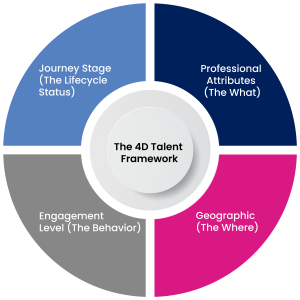
Figure 3: The 4D Talent Framework
- Professional Attributes (The ‘What’- Qualifications)
Skills, certifications, experience, performance, and availability
- Geographic (The ‘Where’ – Logistics)
Location, commute radius, travel flexibility, and licensing
- Engagement Level (The ‘Behavior’ – Interest)
Portal activity, applications, responses, referrals, and content interaction
- Journey Stage (The ‘Lifecycle’ – Status)
Application status, assignment lifecycle, redeployment timing, and inactivity periods
This framework allows recruiters to match opportunities with precision, engage talent proactively, and reduce unnecessary outreach noise.
Personalization Tactics
Personalization only becomes a competitive advantage when it’s systematic — built into the workflow, not bolted on as an afterthought. Here’s what each tactic looks like when it’s done right.
Message Personalization: Move Beyond Templates
The goal isn’t to avoid automation — it’s to make automation feel human.
What it looks like in practice:
- “Your referral bonus for John’s placement is ready for payout” not a generic referral reminder, but a personal one tied to a real event.
- “You applied for a warehouse supervisor role in March. We have a similar opening, with a higher pay rate, 10 minutes closer to your zip code” not a job blast, but a follow-up that acknowledges history
The same message to 500 people without changing a word, it isn’t personalized.
Job Matching: Replace Search with Recommendation
Candidates expect the platform to surface the right roles to them before they search; the way Netflix queues up content you didn’t know you wanted.
Effective job matching goes beyond skills and titles. It layers in:
- Pay Rate History :Recommending roles within the candidate’s expected range, not below it
- Shift and Availability Preferences :Matching schedule compatibility, not just location
- Past Assignment Performance :Surfacing roles where the candidate has demonstrated success
- Commute Radius :Filtering by realistic geography, not just the metro area
A candidate who gets three highly relevant job recommendations trusts the platform. A candidate who gets twenty loosely relevant ones ignores it.
Communication Personalization: Right Channel, Right Time, Right Sender
How you communicate matters as much as what you say.
- Channel Preference: Some candidates respond to SMS within minutes. Others only engage via email. Matching the channel improves response rates.
- Send time Optimization: Messages sent at 8am on a Tuesday perform differently than those sent at 7pm on a Friday. Engagement data should drive timing, not convenience.
- Recruiter Attribution: A message from “Mike at [Company]” the recruiter with whom the candidate spoke to gets opened; generic message from “Talent Acquisition Team” gets ignored or deleted.
Experience Personalization: The Journey, Not Just the Message
The best personalized candidate experience adapts to where they are on their journey.
- New candidates receive awareness content and an easy entry point
- Past applicants receive re-engagement emails when a better-fit role opens
- A candidate currently working on an assignment receives redeployment prompt 30 days before their end date
- High-performing candidates receive a fast-track referral ask while the sentiment is high
When every touchpoint reflects where the candidate actually is recruiting becomes relationship-driven, not transactional.
The Netflix Analogy, Rewritten for Leaders
When choices multiply, value shifts from more options to better decisions. Netflix succeeds not by providing more content, but by transforming data into timely, personal recommendations. Netflix doesn’t find the best movie; it finds the right movie for you at the right moment. Personalization replaces search with relevance, reduces friction, and drives engagement through continuous learning.
The Staffing Parallel: Applying the Netflix Model to Staffing
Netflix logic can redefine staffing:
- Monitor every task like Netflix monitors users’ viewing habits
- Learn success patterns from talent outcomes like Netflix understands viewing communities
- Recommend roles based on contextual fit, like Netflix recommends content
- Predict role fit before roles open like Netflix predicts viewing likelihood
- Utilize intelligent matching to guide careers like Netflix guides viewing journeys

Filling Jobs → Curating Careers

Sourcing Candidates → Predicting Fit

Transactional Hiring → Continuous Talent Intelligence
The Predictive Shift
The future of recruiting is not search—it is recommendation.
Instead of asking “Who is available?” the winners will ask, “Who is the right match?”
That is the Netflix moment for staffing.
The Technology Behind Personalized Recruiting at Scale
Modern staffing requires an integrated intelligence stack that captures talent data, converts it into insights, and activates it using automation. The goal: use AI to profile, segment, match, and engage candidates in real time—improving quality, speed, and efficiency.
- Data Collection: Establish the Talent Intelligence Layer
Create a dynamic 360° candidate view using profiles, assignment history, behavioral signals, performance data, and engagement metrics.
Outcome: A dynamic talent database reflecting capability, intent, and performance. - Processing: Turn Data into Intelligence
Segment talent, predict fit with matching algorithms, personalize communications, and use testing to optimize outreach.
Outcome: Predictive hiring intelligence. - Execution: Activate Intelligence in Real Time
Automate workflows, engage across channels, update status instantly, and optimize through analytics.
Outcome: Faster hiring, smarter engagement, and continuous improvement.
A contemporary talent acquisition platform must function as a closed-loop intelligence system.
Collect (Data)→ Process (Insights) → Execute (Action) → Optimize (Outcomes)
WorkLlama Personalization Engine
The WorkLlama Personalization Engine transforms recruiting into a data-driven talent engagement strategy by treating candidates like customers and talent pools like living ecosystems. Built on AI-driven segmentation, intelligent matching, and omnichannel personalization, it enables organizations increase redeployment, reduce time-to-hire, and build long-term talent loyalty at scale.
Dynamic Talent Pools: From Static Lists to Living Ecosystems
WorkLlama replaces static candidate databases with dynamic, self-refreshing talent pools powered by real-time data and engagement signals.
- 50+ segmentation criteria covering demographic, behavioral, and talent profile data
- Real-time talent profile updates
- Unlimited talent pools per organization
- Nested segmentation with advanced AND/OR logic
This ensures recruiters always engage the right talent at the right time without manual filtering.
Smart Matching: AI That Curates the Right Talent
WorkLlama matches candidates with relevant opportunities using contextual AI.
- Job recommendations based on:
- Past assignment types
- Skills and certifications
- Location and commute preferences
- Pay rate history
- Performance ratings
- Candidate stack ranking through AI-driven fit scoring
- Automatic notifications to candidates for top job matches
This extends naturally into redeployment: WorkLlama triggers proactive job recommendations 30 days before an assignment ends, ensuring the talent relationship continues.
Message Personalization: Human Communication at Scale
WorkLlama enables contextual, omnichannel communication that goes beyond templates-to drive meaningful candidate engagement.
- 100+ merge tags including name, job, recruiter, assignment history, and earnings
- Conditional messaging to different candidates within the same workflow
- Dynamic sender personalization from the assigned recruiter
- Optimal send-time intelligence based on individual engagement patterns
Every interaction feels timely, relevant, and personalized, driving higher response and engagement rates.
WorkLlama turns personalization into a measurable talent growth engine, shifting recruiting from transactional outreach to intelligent, lifecycle-driven management.
Make Personalization the Operating Model
The Netflix model demonstrates that personalization treated as a communications tactic will always fail. Recruiting is still largely a volume game: more candidates, more outreach, more activity. But surface-level customization cannot over fragmented data, reactive sourcing, or platforms that don’t learn over time.

Dynamic Segmentation
replaces static lists.

Predictive Intelligence
replaces reactive sourcing.

Continuous Learning
replaces campaign-based hiring.

Recruiters move from sending messages to orchestrating guided experiences, where every behavioral, contextual, and historical signal informs the next best action.
Figure 5: The Talent Intelligence Loop
Organizations adopting a Netflix-like approach use data and AI to improve candidate matching and engagement over time. Platforms like WorkLlama operationalize this shift by turning talent data into adaptive, real-time engagement systems.
The next phase of recruiting isn’t search. It’s recommendation. And personalization, finally, graduates from a marketing promise to a measurable capability.

