
Healthcare staffing has more than supply problem. It has a coordination problem—and agentic AI makes it possible to connect the right nurse to the right floor before a staffing gap becomes an agency invoice.
Executive Visual Summary

1. The Crisis Has Shifted
Healthcare staffing is no longer only a supply problem. It is a coordination challenge that determines whether the available internal talent reaches the right shift on time.

2. Agentic AI Closes the Gaps
Automated visibility, credential validation, matching, confirmation, and notification help health systems move from manual chasing to closed-loop workforce orchestration, a practical example of hospital float pool automation in action.

3. Float Pools Become Financial Levers
Higher internal fill rates can reduce agency dependence, limit premium labor exposure, and turn healthcare float pool management into a strategic workforce and cost management tool.
Figure 1: Executive Visual Summary
Introduction: The Float Pool Problem That Will Not Fix Itself
What Is a Hospital Float Pool?
A hospital float pool is a group of clinicians—typically nurses, technicians, and other clinical staff deployed across units as staffing needs change.
Float pools offer hospitals a flexible, economical alternative to agency labor. But their value depends on how quickly hospitals can identify who is available, credentialed, and qualified for a specific shift.
The Coordination Gap Behind the Numbers
Travel nurse spending is down from its pandemic peak. Agency rates have moderated.
Ask a charge nurse how it feels at 5:45 a.m., and you will get a different answer.
A unit is short. Patient census spiked overnight. Somewhere in the building, the nurse who could solve it may already be on the schedule, in the float pool, or one call away.
That is the paradox at the center of healthcare float pool management in 2026: the numbers say the crisis has subsided. The floor does not feel that way.
A float pool nurse may have the exact competencies a unit needs today. A per diem clinician may be free and willing. A travel nurse may be finishing an assignment and ready for the next one through travel nurse redeployment strategies.
The workforce often exists. What does not exist is a system that can identify, verify, and deploy the right clinicians in time.
Most health systems still coordinate staffing manually through phone calls, texts, spreadsheets, and credential checks after a match is made. The expense shows up on the labor line as premium pay. Operational friction prevents systems from answering one question quickly:
Who is qualified, compliant, available, and likely to accept this shift right now?
Conventional workforce tools can display that information. Agentic AI can orchestrate the process by detecting the gap, matching the clinician, validating eligibility, and initiating outreach automatically through an AI healthcare staffing platform.
The health systems that succeed in 2026 will not be the ones that hire more nurses or negotiate better agency rates. They will be the ones that turn the float pool from a backup plan into a strategic labor lever.
This blog examines the coordination gaps agentic AI closes, what an automated fill workflow looks like in practice, why float pool performance belongs to strategic financial planning—not day-to-day staffing operations, and how to manage a hospital float pool going forward.
The State of Healthcare Staffing in 2026
Healthcare staffing is quieter, not easier.
Revenue and spend can improve while staffing remains fragile. Health systems may reduce agency use and labor costs—yet lack confidence that every unit and specialty shift will be covered on time.
Post-Pandemic Correction: What Changed and What Did Not
| Market Stabilization | Operational Pressure |
| ✓ Travel nursing premiums eased | ⚠ Demand still outpaces supply |
| ✓ Permanent workforces rebuilt | ⚠ Experienced RNs remain hard to recruit and retain |
| ✓ Flexible staffing became more deliberate | ⚠ Nights, weekends, ICU, ED, and labor and delivery still strain coverage |
| ✓ Focus shifted from crisis response to long-term labor strategy | ⚠ Manual workflows slow in-house talent deployment |
Figure 2: What Changed and What Did Not Change Post-Pandemic
The Shortage Underneath the Stabilization
The Registered Nurse (RN) market is the clearest signal. National vacancy rates may look manageable, but averages hide pressure by geography, specialty, and hospital type.
RN vacancy remains stubbornly high. Many hospitals carry double-digit vacancies, and specialty roles can take weeks or months to fill—creating coverage gaps despite improving labor trends.
The shortage is local, too. Metro systems compete for the same specialty nurses; rural hospitals face smaller pools and fewer alternatives.
Why Health Systems Are Doubling Down on Float Pools and Where the Model Breaks
Internal float pools reduce agency dependence—improving continuity and lowering labor costs.
But float pools only work when activated quickly.
A large pool has limited value if leaders cannot see who is available, credentialed, compliant, and shift-ready. Too often, that information sits across spreadsheets, staffing systems, text threads, and manager knowledge. Hospitals escalate to agencies because they cannot identify and deploy internal clinicians fast enough.
Stabilization has bought time—not solved the challenge. Advantage will come from activating internal talent faster and making healthcare float pool management a strategic capability supported by healthcare workforce management software.
Why Do Hospital Float Pools Fail to Reduce Agency Dependence
The operational barriers include manual scheduling, limited visibility into clinician availability, and slow credential validation. When coverage is most needed, hospitals often overlook available, qualified clinicians.
The biggest bottleneck is the charge nurse. The person in charge of patient care is also expected to coordinate staffing—contacting clinicians, verifying credentials, and filling shifts within the time constraints. That is manual coordination, not workforce optimization.
Per diem employees face the same challenge. Without per diem nurse scheduling AI to identify and engage them as soon as a matching shift becomes available, internal capacity is wasted and the agency becomes the backup.
The problem is not the float pool; it is the workflow. Without real-time visibility and quick workforce activation, hospitals cannot convert internal talent into dependable shift coverage or reduce travel nurse agency spend.
The Three Coordination Gaps Agentic AI Closes
Since coordination is exactly what agentic AI systems are designed to execute, they map naturally to this challenge as a form of AI for healthcare contingent workforce management.
Three operational coordination gaps consistently compromise float pool performance:
Gap 1: How Do You Track Float Pool Nurse Availability in Real Time?
Visibility is no longer about checking lists faster—it is about eliminating the gap between need and action.
When coverage is required, qualified clinicians can remain difficult to identify because manual staffing relies on phone calls, text messages, and spreadsheets that become outdated quickly.
Instead of coordinators searching after a gap appears, agentic AI creates a live view of who is available, credentialed, willing to work, and qualified, then proactively identifies and engages the right workers before a shift goes uncovered. This shifts staffing from reactive scrambling to real-time workforce coordination, powered by float pool staffing AI and AI for healthcare contingent workforce solutions.
Gap 2: How Do Hospitals Automate Nurse Credential Verification for Scheduling?
Finding an available nurse is half the job. Confirming that they are credentialed is the other half. It is not enough for a clinician to be available; they must be immediately eligible to work. Most hospitals verify credentials after identifying a candidate. If a license, certification, or unit competency is missing, the search starts over, delaying coverage when time matters the most.
Agentic AI integrates credential management automation for healthcare directly into the matching process. The system pre-validates every recommendation against licenses, certifications, competencies, compliance rules, and expiration dates—so only qualified clinicians surface. Compliance becomes part of the match, not a bottleneck after it, enabling faster, safer staffing.
Gap 3: How Do You Reduce Travel Nurse Turnover with Proactive Redeployment?
Travel nurses and per diem clinicians rarely leave because they want to. They leave because no one reached out with the next opportunity before the assignment ended. The assignment end date is one of the most obvious—and most underused—signals in hospital workforce management. It is known weeks in advance, yet it sits passively in a system until the clinician has already accepted a competing offer. By then the hospital is paying to recruit, onboard, and ramp a replacement. Contract expiration dates should function as retention triggers, not administrative milestones.
Agentic AI continuously monitors assignment end dates, demand forecasts, clinician fit, and compliance to identify redeployment opportunities before contracts expire, triggering outreach while retention is still possible. Nurse redeployment workflow automation makes redeployment proactive. The result: higher retention and lower turnover, recruiting expenses, and agency dependence.
How Does AI Automate Float Pool Scheduling in Hospitals?
Agentic AI can help predict staffing gaps and coordinate the actions needed to close them. It transforms staffing from a manual scramble into a healthcare shift coverage automation workflow—from shift gap to confirmed coverage.
Figure 3: Six-Step Float Pool Staffing Workflow
- Detect: An uncovered shift is automatically identified.
- Assess: Available float, per diem, and internal clinicians are evaluated in real-time.
- Verify: Credentials and compliance are verified automatically.
- Match: The best-fit clinician is identified and notified.
- Confirm: Acceptance updates schedules and records instantly.
- Notify: The charge nurse is informed once the shift is covered.
The goal of agentic AI in healthcare staffing is to create a workflow layer that identifies the gap, reasons through constraints, acts on the next best step, and closes the loop, allowing teams to move from pursuing coverage to managing exceptions—the foundation of modern hospital float pool automation.
How WorkLLama Brings This Workflow to Life
WorkLLama turns healthcare float pool management from a reactive staffing exercise into an intelligent, always-on workforce engine. Its agentic AI continuously monitors demand signals, upcoming assignment end dates, credential status, worker availability, and location preferences to identify coverage gaps before they disrupt care.
When the need emerges, WorkLLama identifies qualified clinicians, validates eligibility, triggers personalized outreach, and initiates redeployment workflows before assignments end. By automating the coordination between workforce data, staffing teams, and clinicians, WorkLLama creates a closed-loop operating model that accelerates internal fill rates, reduces manual handoffs and agency dependence, and helps health systems control labor costs while keeping care teams covered—delivering hospital float pool automation as part of a modern AI healthcare staffing platform.
How Much Does a Hospital Save by Using a Float Pool Instead of Agency Nurses?
Healthcare leaders often treat float pool performance as an operational coverage issue; however, it goes beyond that. When premium labor erodes margins quickly, every missed internal fill has a financial impact. This makes float pool performance an operating cost decision—and a clear case for healthcare labor cost reduction AI.
The ROI is straightforward: fixed infrastructure versus variable agency cost. As internal fill rates improve, savings compound without increasing program costs—a key part of any float pool vs. agency nurses cost comparison and strategy to reduce travel nurse agency spend.
| Cost-Impact View: Float Pool Activation vs. Agency Dependence | ||
| Cost Lever | Float Pool Model | Agency-Heavy Model |
| Cost Structure | Fixed infrastructure investment stays relatively constant as usage increases. | Variable premium cost that increases with every unfilled internal shift. |
| Fill-Rate Improvement | Higher internal activation compounds savings without proportionally increasing program cost. | Lower internal activation increases agency coverage and premium labor costs. |
| Operational Impact | More predictable coverage, less administrative chasing, and stronger workforce continuity. | Increased escalation, higher spend volatility, and greater dependence on external labor. |
Figure 4: Cost Impact View
What a 10-Point Fill-Rate Improvement Is Worth
The case for float pool investment is easier when it is expressed as arithmetic rather than principle.
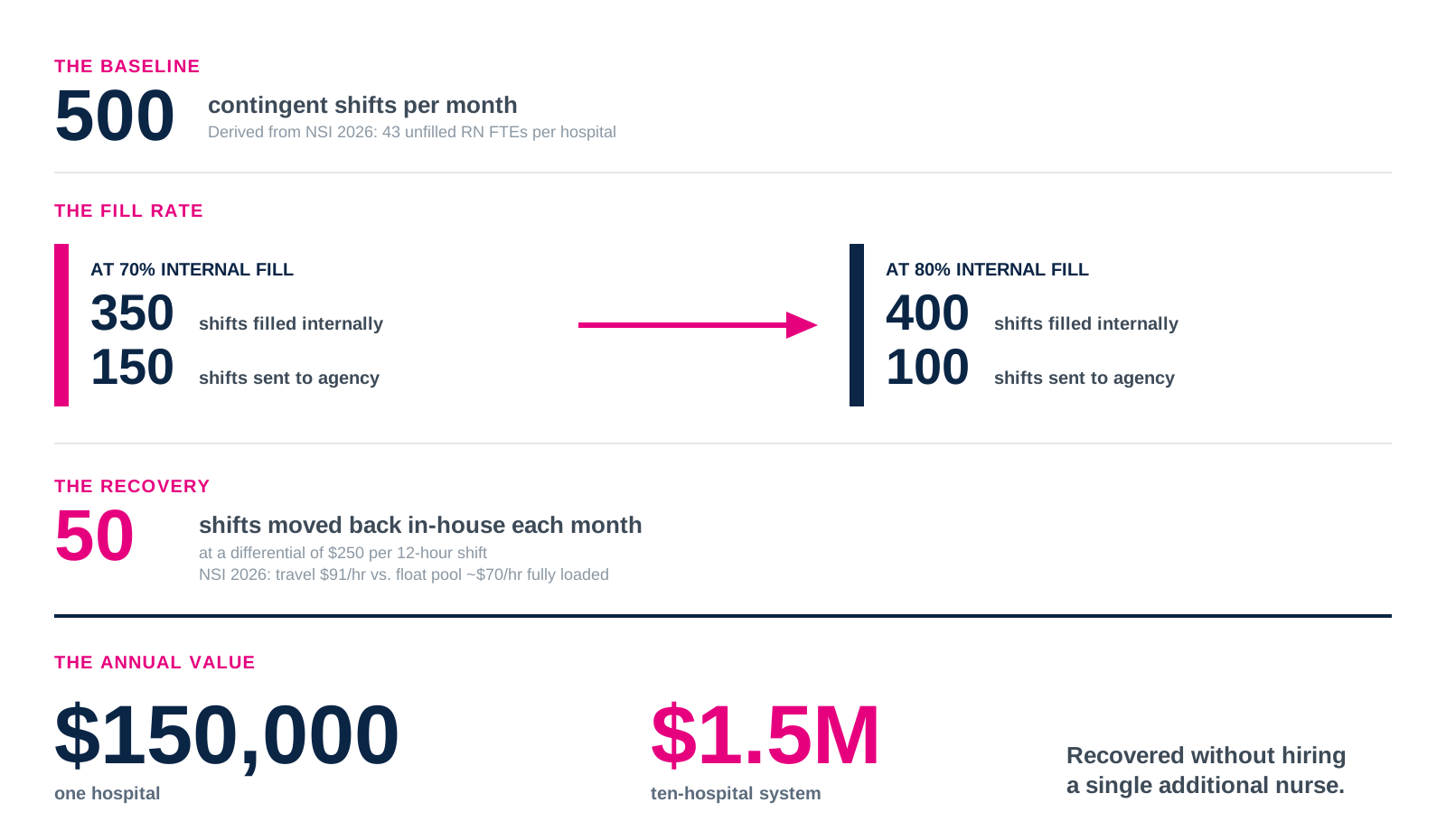
The 2026 NSI National Health Care Retention & RN Staffing Report puts the national RN vacancy rate at 8.6%, with the average hospital carrying 43 unfilled RN Full-Time Equivalents (FTEs). That translates to roughly 500 contingent shifts a month requiring coverage—before callouts, PTO, or census surges.
NSI also reports travel nurse rates now average $91 per hour. A fully loaded float pool nurse—base wage, float differential, and benefits—runs closer to $70. The difference is about $21 per hour, or roughly $250 on a 12-hour shift.
Now apply the fill rate. A manually coordinated float pool operating at 70% internal fill sends 150 of those 500 shifts to agency coverage each month. Improving internal fill to 80% moves 50 shifts a month back in-house.
At $250 per shift, that is $12,500 per month—$150,000 annually—per hospital. Across a 10-hospital system, the same 10-point improvement is worth $1.5 million a year, recovered without hiring a single additional nurse.
Infrastructure cost does not scale with the number of shifts filled; the agency premium does. That asymmetry is the entire financial argument: every point of fill-rate improvement compounds against a fixed cost base, and every internally filled shift is one fewer agency invoice.
What Technology Is Needed to Automate Healthcare Float Pool Management?
An algorithm is not the first step in agentic float pool management. Operational reality is where it all starts. Before health systems trust automation to identify gaps, match qualified clinicians, and trigger next-best actions, they need the data and infrastructure that allow the agent to make decisions based on facts—not assumptions.
The real question is not whether AI can optimize staffing—it is whether the environment is ready for hospital float pool automation, or whether the organization is evaluating float pool scheduling software 2026 that buyers can trust.
- Accurate Data Makes Availability Visible
AI only acts based on what it can see. Automation is only as intelligent as the data that powers it. Real-time visibility into shift preferences, schedule changes, and employment status must replace texts, spreadsheets, and institutional memory. - Searchable Credentials Make Matches Safe
Accurate, searchable credentials and competencies enable confident matching. When a clinician is identified, their licenses, certifications, and compliance records must be up to date and available. - Connected Systems Make Matches Actionable
Automation depends on integration. Scheduling, Human Resource Information System (HRIS), timekeeping, credentialing, payroll, and shift records must collaborate to eliminate manual re-entry and reconciliation. - Defined Guardrails Make Automation Accountable
Agentic AI needs defined rules. Clear thresholds determine when it acts, escalates, or initiates alternatives such as agency, overtime, or acuity modifications.
The Float Pool Is Not a Backup Plan
Healthcare staffing is often viewed as a supply problem: not enough nurses, applicants, or coverage. However, coordination is the greater challenge.
Can hospitals identify the right clinician, verify credentials, provide the right opportunity, and cover the shift before a gap becomes a crisis?
Agentic AI closes that coordination gap. It does not replace clinical judgment—it eliminates manual searching, calling, checking, and delays that restrict workforce agility.
The future belongs to health systems that coordinate better, not just hire more.
In 2026, leading organizations will stop viewing float pools as contingency resources and start treating them as strategic workforce infrastructure—driven by real-time visibility, automated credential matching, proactive redeployment, and intelligent workflow orchestration.
The opportunity is straightforward: connect the right clinician to the right shift at the right time—with speed, confidence, and less administrative burden, through healthcare float pool management built for 2026 and beyond.
Request a Demo
Discover how agentic AI can modernize float pool management, reduce agency costs, and transform workforce coordination.

